Sierra Leone-UK Trade: A Relationship Running on Empty
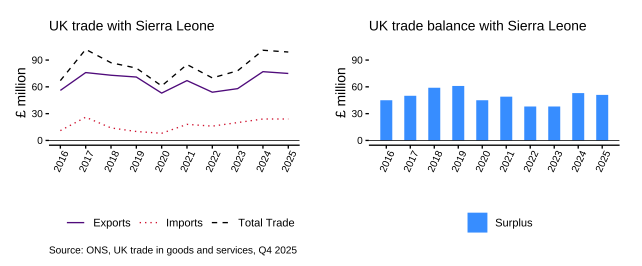
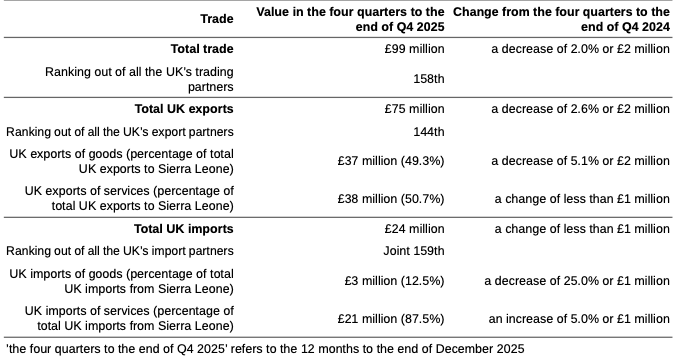
The latest UK–Sierra Leone trade figures should unsettle anyone who still believes this bilateral relationship is on a path to meaningful economic partnership. At £99 million in total trade for the four quarters to Q4 2025—a marginal 2% decline from the previous year—Sierra Leone ranks as the UK’s 158th trading partner, accounting for less than 0.1% of Britain’s global trade. These are not the numbers of a strategic relationship. They are the numbers of a partnership stuck in neutral.
The breakdown is revealing: • UK exports to Sierra Leone fell by 2.6%, dropping to £75 million. • UK imports from Sierra Leone barely moved, stuck at £24 million. • Sierra Leone’s FDI into the UK collapsed by 50%, down to a symbolic £1 million. • UK FDI stock in Sierra Leone is not even published, due to disclosure limitations—usually a sign of extremely low or highly concentrated investment.
This is not a trade relationship; it is a transactional trickle.
Sierra Leone’s export profile remains dangerously narrow. The country continues to rely on a handful of primary commodities, with minimal value addition and limited competitiveness in higher‑value markets. The UK, meanwhile, has not expanded its commercial footprint beyond traditional sectors. There is no surge of British investment in agribusiness, tourism, renewable energy, or digital infrastructure—sectors where Sierra Leone has clear comparative potential.
The result is predictable: imports dominate, exports stagnate, and the trade gap widens.
Foreign direct investment is the engine of structural transformation. Yet: • UK investment in Sierra Leone is so low it cannot be publicly disclosed. • Sierra Leone’s investment in the UK is negligible and shrinking.
Without investment, there is no technology transfer, no job creation, no diversification, and no pathway to export competitiveness. The absence of FDI is not a footnote—it is the central failure of this bilateral relationship.
Sierra Leone’s development ambitions—industrialisation, value addition, export diversification—cannot be achieved with a trade relationship this anaemic. A country of Sierra Leone’s potential should not be trading at levels comparable to microstates. Nor should it accept a static relationship with a major global economy that has historical ties, a large diaspora, and significant development influence.
The current numbers reflect a deeper truth: Sierra Leone is not yet positioned as an investment‑ready, export‑capable partner in the eyes of UK businesses.
For Britain, the data exposes a gap between rhetoric and reality. Post‑Brexit, the UK has repeatedly promised a renewed economic partnership with Africa. Yet the Sierra Leone figures show no evidence of strategic engagement, no commercial ambition, and no meaningful investment push.
If the UK intends to be a serious development and trade partner, it cannot allow its engagement with countries like Sierra Leone to remain frozen in the past. Both countries need a reset—one grounded in strategy, not sentiment.
Sierra Leone must: • Expand export capacity beyond raw commodities. • Strengthen standards, certification, and market readiness for UK/EU markets. • Use ATIDI membership and investment guarantees to de‑risk British investment. • Build targeted investment promotion pipelines for UK firms.
The UK must: • Prioritise Sierra Leone within its Developing Countries Trading Scheme (DCTS). • Deploy blended finance to support value‑addition industries. • Encourage British companies to explore opportunities in energy, mining services, tourism, and digital infrastructure. • Rebuild investor confidence through predictable, transparent engagement.
The UK and Sierra Leone share history, people, and values. But history cannot substitute for strategy. The current £99 million trade relationship is not just small—it is unacceptably small for two countries with such deep ties.
If both governments fail to act, this partnership will continue to drift. But if they choose to act—boldly and deliberately—Sierra Leone and the UK can transform a stagnant relationship into a genuine engine of shared prosperity.